
I’ve interviewed Mark Ryden a few times over the years and what always surprises me is how much he lives in the present. For a painter who has for nearly 30 years worked within and through a particular part of American folklore and international myths, I thought of him as a historian of a painter. But that opinion has shifted over the years as I have begun to know Mark better, and with his move from southern California to Portland in recent years has made the painter a bit more open to discourse in his work.
For the first time in what appears to be over a decade (not counting a special pop-up with Barbie in 2022) that the Godfather of Pop Surrealism has been showing in the city that was so crucial to both his growth and the movement itself. There was a time in the 1990s and early 2000s where LA was home to an alternative art scene that bore some of the greats and was fostered by the likes of Ryden, Robert Williams, Todd Schorr, Camille Rose Garcia and galleries like Merry Karnowsky and Billy Shire. There was a certain and particularly cinematic buzz and aesthetic to this time and era, where the artists became set designers to an otherworldly but deeply poetic universe of surrealistic dreams.
Ryden for his part has navigated the blue chip world and post Post Surrealism boom and has become not only a sought-after artist with collectors but a statesman of the just-outside-the-normal-logic-of-our-world style of painting that finds company in the John Currins and Glenn Browns of our world. I wanted to talk to Ryden on the occasion of Eye Am, his newest solo show at Perrotin in Los Angeles and ask him how it feels to be back in such place that is vital to his artistic DNA, and what he thinks about myth-making in 2025.

Evan Pricco: I want to know, first off, what it feels like to be showing back in Los Angeles. So much of your career was established here, and in many ways, your work and career represents such a pivotal aesthetic of what helped bring "pop surrealism" to a global audience. My question would be what does LA mean to you, and do you look back at your contribution to this city in a fond way?
Mark Ryden: LA still feels like home to me in many ways, having lived there for so much of my life, although I don’t miss the hot sun or the traffic. What Los Angeles has always offered is a sense that anything can happen. People there tend to be more open to new ideas, and there is less of an old-guard, gatekeeper mentality when it comes to the art world.
When I first began showing in galleries, I felt a sense of freedom to do work that was, at the time, very out of the ordinary. I’m not sure I could have had that same freedom anywhere else. I think there’s a reason Pop Surrealism took root in places like Los Angeles, San Francisco, and Seattle. There was a shared openness and curiosity that allowed something new to grow, and I look back on that period, and my connection to the city, with a lot of fondness.
EP: I have never asked you this, but do you like the term "pop surrealism," because whether or not you find it appropriate as a moniker, your work is associated with it.
MR: Pop Surrealism was a difficult label for an art movement because it encompassed so many diverse artists. Still, it pointed to something real. Many of us were tired of the old, stale ways of thinking about art, a desire to return to figuration, and a dissatisfaction with the sterile intellectual elitism that had taken over the art world in the latter half of the last century. Most people felt little connection to it and simply didn’t care about it.
That has changed. It’s been nice to see younger generations actively seeking art and going to exhibitions.
So, while the label isn’t perfect, I do feel it suits me in that sense. It reflects a moment when art began to reconnect with imagination, emotion, beauty, and soul.
EP: Let's talk about Eye Am, the yam, if you will. Yams have been depicted in art to symbolize fertility, abundance, and connection to land, but not necessarily in this context you place it in. You do a ton of research for your work and your shows, there is a logic to how you include historical figures and objects, but I'm curious of the yam's influence here?
MR: I always understand the impulse for a clear explanation, but I didn’t set out to include yams with a particular meaning in mind. They appeared naturally as my work developed without any conscious decision on my part. I didn’t begin painting this show thinking, “I am going to paint yams.”
While I do a lot of “research” and preliminary work, my paintings don’t come together through logic or intention. The images emerge from intuition and the subconscious, things that resist tidy explanations. My process involves filling my mind with input, but then, in a sense, turning it off while I’m creating. I turn on all my other senses instead: music for my ears, incense for my nose, inspirational images for my eyes. That is when the art is born. Meaning comes through the image itself, not from an explanation placed on top of it.

EP: There is always a myth in your work. What I always loved and assumed you were doing with the audience is demystifying the history of painting, our pop-cultural history, our political history. Right now in America, there is the myth of the good old days, this return to some mid-century utopia that never actually existed but we are forced to reckon with it. Does demystifying what it is to be American, our history, is that part of the work?
MR: I am interested in how things get simplified and romanticized over time. In America especially, there’s a strong desire to imagine a “good old days” that never really existed, a kind of manufactured nostalgia that ignores a lot of complexity and contradiction. My exhibition “The Gay 90’s” explored some of these ideas. I find it all fascinating, and it naturally ends up in my work without any particular agenda. I never set out to be political, and I don’t approach the work with the intention to demystify anything. They appear in my work simply because they are part of the world I observe.
EP: Your muse, Mr. Lincoln, returns in Meat Choice #186, 2025. I want to know how your relationship with Abe has evolved, and really any of your subjects, how you feel to be painting him after all these years, if the meaning changes?
MR: Going back almost thirty years, I first included Abraham Lincoln as a character in my art in a surreal way. At the time, I hadn't seen anyone else doing that. In the years that followed, I began to notice him appearing as a surreal character in other art and media. I even remember a strange TV commercial where he was part of someone's dream. I have to admit, that felt a little frustrating - Hey, Lincoln “belongs” to me!
But l've come to realize that, like many things I include in my work, there's a collective zeitgeist at play, and I just happen to tap into it early. Even though using Lincoln is no longer unique to me, he remains a permanent part of my lineup of characters and subjects. I enjoy watching how he continues to evolve in my work.
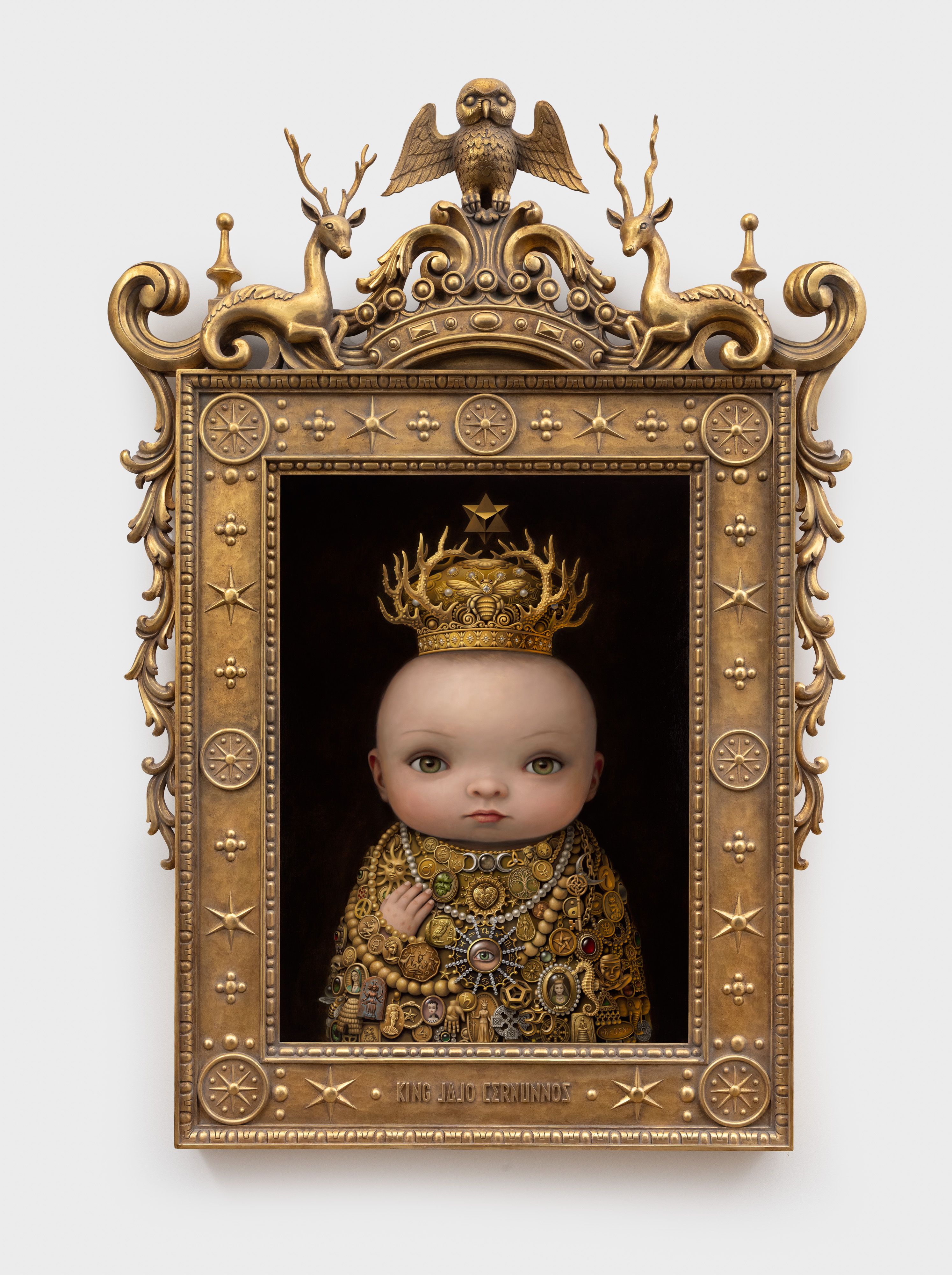
EP: To get specific, the work King Jajo Cernunnos #180 is one of the absolute standouts of the show. It's a hearty, meaty work, with just a thick masterful frame and a peculiar subject. And it's a return to quite an early work of yours from 1994. There is a reference to the ancient Celtic deity who acts as a mediator between humans and the natural world, and obviously your work has spoken of this relationship for years. And we have definitely fucked up this relationship, to say the least. You are politically engaged on your social media, you never shy away from politics, but have you ever found it difficult to be a political painter?
MR: I just see myself as a political painter, though I do have strong political beliefs, especially given what is happening in the world right now.
My intention with my art is more spiritual. I've always found the natural world to be a source of inspiration, not any organized monotheistic religion that says man shall have dominion over the earth and all the other species on it. I believe we should live in harmony with all the creatures we share this planet with. In my work, I try to reflect that sense of balance, showing the beauty of a life in connection with nature.


EP: I thought this immediately when I saw it, but The Sentinel #177 feels like the centerpiece of your whole universe creation. The 2001 reference, the monolith, this awakening or unlocking a world, or a force, this work seems to be the awakening of the universe your characters live in. Can you tell me about this one?
MR: It is one of the smallest pieces in the show, but so many people have singled it out as speaking to them. That is very satisfying. If it inspires someone to imagine what might be happening, then I feel have reached their soul, not just their mind. To me, that is success.
One of my earliest memories is watching 2001: A Space Odyssey with my family, lying on the roof of our station wagon at a drive-in. Those images of mystery and the unknown stayed with me, and the monolith naturally found its way into this work. I named the painting The Sentinel before realizing Arthur C. Clarke's story of the same name inspired the 2001 screenplay. I love synchronicities like that, they feel meaningful and often guide how a piece comes to life.
EP: Both the works on paper and the references to your research are prominent in this show. What does working on paper do for your practice? They are incredible insights into your talent and your imagination.
MR: Working on paper is where everything starts out. It's where ideas are free to evolve quickly, without pressure, and where things can take unexpected turns. It's a place where the imagination has room to breathe. The drawings can show the way my mind wanders around, experiments, and discovers the images that eventually make it into the final work.


EP: I want to know who Mark Ryden, someone who is admired by so many, is looking at right now as a painter you admire? So many admire you, but who influences you?
MR: There are so many incredible new artists to discover online if you want to look, and new work appears every day. It's almost impossible to remember all their names. I actually feel a little sorry for young artists starting out, overwhelmed by so much imagery. How do you even begin to find your own voice?
For my own inspiration, I still return most often to the old masters, and to the bric-a-brac and collectibles I've gathered over the years. There is something about these objects and works that continues to spark ideas in ways that are quiet, personal, and enduring.
EP: I found it hard this year to remain optimistic, but I see a light here and there. What are you optimistic about going into 2026?
MR: I also find it hard to remain optimistic these days. For me, the light comes from tuning out the outside world and retreating to my home to quietly make art. I do believe that creativity, beauty, compassion, and kindness are still present in the world, if you know where to look. I try to surround myself with people who share that outlook, and that gives me hope.

Published on


.jpg?w=120&h=120&fit=crop&q=80)


